Frequently asked questions
Here you’ll find the most frequently asked questions, answered by us.
27 questions in 5 topics
Product & Water Quality
7What exactly is the Urquelle Diamant?
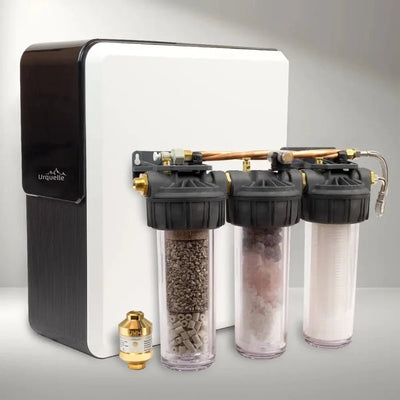
The Urquelle Diamant is a water filtration and purification system. It transforms tap water into a highly pure, remineralized, and above all, energetically full-spectrum Urquell water quality – comparable to water from the highest and most pristine mountain springs.
Why should I choose the Urquelle Diamant?
The Urquelle Diamant combines the most important and precise filtration technologies with a unique force field technology and 24-karat gold plating. It works on the model of nature and produces highly pure, remineralized, hexagonal, full-spectrum energized, revitalized, and restructured water.
In addition to our gold plating techniques, we chose a technology that has been certified with 26 documents. Our team has been working with water treatment for a long time – that is why only the highest quality materials and technologies were incorporated into the Urquelle Diamant. And all our passion.
Taste and effect are comparable to untouched spring water from high mountains.
What characteristics does high-quality water have?
High-quality spring water – from pristine springs as well as mountain and forest springs that have not been heavily impacted by our civilization – is characterized by four features:
- High-purity: It does not bind harmful substances such as chemicals, microplastics or heavy metals, nor is it over-mineralized. It merely contains a sediment of organic minerals. Completely demineralized water is virtually non-existent in nature—it is considered energetically unstable and prone to bacterial contamination. Over-mineralized water, on the other hand, is too highly saturated and can have a negative effect on the body.
- Balanced, unbuffered pH: slightly acidic to neutral or very slightly alkaline, ideally between 6.4 and 7.4 – just like most water sources in the world. In our opinion, alkaline water should only be used in the short term in cases of severe acidosis.
- Hexagonal Structure: Water researcher Dr. Masaru Emoto demonstrated with his water crystal photography that water from a harmonious environment forms beautiful, hexagonally arranged crystals. Hexagonal water is also described as H3O2 and tastes refreshing, smooth, and full-bodied at the same time.
- High energy level: Like everything in existence, water has its own radiance, its own vibrational level. High-quality spring water always possesses a high energy level.
Urquelle Diamant takes all these factors into account and produces a highly pure, pH-neutral, remineralized, hexagonal, and energetically full-spectrum spring water quality – following the model of nature.
Why should you drink spring water of the highest quality?
Compared to tap water or conventional bottled water—which, by the way, is tested for only 16 out of more than ten thousand potential contaminants—high-quality spring water has a highly harmonizing, invigorating, and restorative effect on the mind-body-soul system.
The key is so-called cellular permeability: only when water is highly pure and at the same time hexagonal or revitalized can our cells optimally absorb and utilize it. As a rough guideline for highly pure water, conductivity should be below 100 µS (ideally 40 to 90 µS), or below 50 ppm (ideally 20 to 45 ppm).
Depending on age, our bodies consist of 50 to 80% water. High-quality spring water should therefore be the most important elixir of life for us.
Why should water be highly pure?
Tap water can contain different dissolved substances and residues depending on its source and the pipe network.
Highly pure water, on the other hand, has a strong dissolving and transport capacity. This allows it to dissolve sludge, acids, and other toxins, while simultaneously absorbing minerals and vital nutrients that we consume through food. Water should therefore always be highly pure – just as it is in nature.
This is why highly precise filtration technologies are used in Urquelle Diamant. They remove, among other things, traces of medication, light and heavy metals, sediment, limescale, microplastics, hormones, plasticizers, fluoride, microorganisms, and countless other chemicals from the water.
Why should the pH level be in the slightly acidic to neutral range?
Some systems shift water into a highly alkaline range through electrolysis. This only works with saturated, i.e., impure, water. The pH level is then buffered (inflexible) and, over time, the highly alkaline composition can damage the stomach lining.
Nature paints a different picture: Most springs are highly pure and range from slightly acidic to neutral—between pH 6.4 and 7.4.
Our water is treated following this model: It falls within this range (varying slightly depending on the source water) and has an unbuffered, flexible pH level.
Why is the microsiemens value only a limited quality criterion?
The microsiemens value (µS) measures the electrical conductivity of water. The higher it is, the more electrically conductive substances are dissolved and the more saturated the water is. Some manufacturers consider this the most important quality indicator. This is an oversimplification:
- Most conductive substances are minerals. A high reading therefore does not automatically mean that the water is contaminated.
- Contaminants usually fall within a very small µS range. A TDS meter cannot detect them – a detailed laboratory analysis is always required for that.
- Many substances are not electrically conductive at all and are not detected at all.
- Not every remineralization process transfers conductive minerals: The Maifan rock in the Urquelle Diamant releases mostly non-conductive, bioavailable minerals. This is why the reading remains low after filtration. The remineralization only becomes visible with an indicator test.
The microsiemens value therefore only provides a rough indication – for example, to detect highly saturated water. It should still not be too low (keyword: aggressive water).
Technology & Filtration
7What is an osmosis or reverse osmosis system?
Reverse osmosis is the most effective and precise method, alongside distillation, for removing contaminants and fine substances from water at the molecular level.
Water is forced under pressure through a molecular membrane that acts like a very fine sieve. It retains heavy metals, pharmaceutical residues, microplastics, herbicides and pesticides, nitrates, fluorides, minerals and many other substances. This is why reverse osmosis is one of the most reliable filtration technologies.
Why do we use reverse osmosis technology?
Urquelle Diamant operates on the principle of "filtration, renaturalization, and remineralization". For filtration, we combine activated carbon from coconut shells with a high-performance reverse osmosis system:
- Three-stage pre-filter consisting of a 1-micron, a 5-micron, and an activated carbon unit – it removes coarse and fine organic substances and ensures basic purification.
- 800-GPD molecular membrane – it filters at the molecular level using the reverse osmosis principle, allows for a high flow rate, and is usable for years thanks to its size and performance.
This is how we consistently ensure deep filtration and a high flow rate.
What are the advantages and disadvantages of an osmosis system?
Osmosis technology is perfectly suited for deep filtration: it reliably removes contaminants from tap water at the molecular level – even over long periods. However, it also has serious disadvantages: The water loses all minerals and thus its natural resonance foundation, it becomes too pure and can act aggressively in the body. The pH value drops by around two levels due to pressure filtration, and large water clusters are formed in which the information of the contaminants is preserved.
- Filtration at the molecular level
- Reliable removal of all contaminants
- Long-lasting technology
- Years of use depending on quality
- Water becomes acidic due to the pH level
- Large water clusters are formed
- Information about contaminants remains
- All minerals are removed
- The water must subsequently be fully re-mineralized
That is why the water in the Urquelle Diamant is renaturalized and full-spectrum energized after filtration: volcanic rock, dolomite rock, and Sango sea coral return a sediment of bioavailable minerals to it, while an EM ceramic breaks down the large clusters. Then it comes into contact with fine gold, diamond, rock crystal, rose quartz, amethyst, and premium shungite, and passes through UMH Pure Gold, a vortex implosion tube, and Agnihotra ash.
Why don't we use UV-C germ protection?
Many devices kill 99.9% of bacteria, germs, and viruses with a UV-C or LED germ barrier. In our view, this is counterproductive: The water is exposed to strong radiation inside the device and becomes sterile—which does not follow the example of nature. Furthermore, its bioenergetic fields are destroyed, so that even powerful revitalization techniques can hardly restore them.
We therefore refrain from doing so and reduce germs instead with these components:
- Strong pre-filtration: It removes a large proportion of bacteria and viruses right at the beginning.
- Natural germ filter: It retains 99.9% of germs while simultaneously preventing bacterial growth in the device.
- Maifan mineral rock and other precious stones: Maifan, premium shungite and rock crystal have antibacterial properties.
- UMH GOLD technology: 24-karat gold is a precious metal with antibacterial properties; the concentrated energy field of the UMH naturally reduces and inactivates germs.
What material are the cartridges and tubing made of?
All cartridges and tubing are made of high-quality polypropylene (PP), a food-safe plastic. PP is odorless, skin-friendly, and free from harmful plasticizers and harmful additives – that is why it is also used for medical devices.
Polypropylene is virtually neutral in relation to water. This preserves the physical and energetic neutrality of the water.
How many liters of purified water are produced per minute?
The Urquelle Diamant delivers a flow rate of just under 1.5 liters of water per minute.
What is the wastewater ratio?
The wastewater ratio is 1 : 1 – for every liter of spring water, one liter of wastewater is discharged down the drain. This is a low consumption rate for water filtration devices.
For comparison: Industrially bottled water generates up to six liters of wastewater when the individual bottles are rinsed.
Mineralization & Revitalization
6Why is our water remineralized?
Thorough filtration removes not only impurities but also all minerals. This is initially necessary, because the minerals in tap water are mostly inorganic and barely bioavailable.
Completely demineralized water, however, is aggressive – its solvency is so strong that over time it can even strip away metals. Furthermore, it contradicts the model of nature: The purest springs in the world always contain a sediment of bioavailable minerals. These serve less to supply our bodies. Rather, they ensure that water loses its aggressiveness, can be easily energized, and remains energetically stable for a long time. Demineralized water, on the other hand, is very susceptible to germs – it sours quickly and spoils under sunlight.
In the Urquelle Diamant, the filtered water is therefore lightly remineralized just before revitalization with Maifan volcanic rock, Sango sea coral, and dolomite rock. The alkaline-active minerals and trace elements are highly bioavailable, bring a harmonious base frequency, and increase the oxygen concentration of the water.
Why do we use volcanic rock and Sango coral for mineralization?
Maifan volcanic rock finds a wide range of applications in Far Eastern natural medicine, where it is associated with the longevity of peoples living in volcanic regions. It contains valuable components such as silicates, plagioclase, orthoclase, and silicon. When in contact with water, it imparts freshness and naturalness, gently optimizes the pH level, and creates a taste similar to mountain spring water.
Sango Sea Coral It is obtained 100% from natural marine coral fossils from Okinawa. It releases over 70 alkaline-active minerals and trace elements into the water – including calcium and magnesium in a 2:1 ratio, as well as zinc, copper, selenium, manganese, potassium, silicon, iron, and iodine.
After this mineralization, the pH level varies between 6 and 8 depending on the region, while the conductivity is in the ideal range of around 50 µS (approximately 25 ppm). The water remains energetically and structurally stable for a long time and does not spoil like conventional reverse osmosis water when exposed to sunlight.
Why is our water full-spectrum energized?
Water, like everything in existence, possesses energetic signatures, bioenergy fields, vibrational fields, and other vital structures. Tap water no longer possesses any of these vital structures: it is energetically "dead".
Full-spectrum energizing therefore restores the entire energetic spectrum of the water. All fields are restructured and important frequency peaks are restored – the water is completely revitalized.
Why should water not only be energized, but also revitalized?
For tap water, simple revitalization is not enough. It has been irradiated in treatment plants to reduce germs, passed through contaminated pipe systems, and was exposed to countless chemical contaminants – its structures are severely compromised.
For water to become “whole” again, its bioenergy, information, and vibrational fields must be restored and its energy level raised. This can only be achieved through a combination of different revitalization techniques. In Urquelle Diamant, these are:
- a special clay ceramic (EM) as a base
- high-quality Maifan mineral rock
- a wide range of rock crystals
- a wide range of rose quartz
- a wide range of amethysts
- the energy field of Agnihotra (sacred ash)
- a base layer of premium shungite
- a 1.5 m long vortex
- a genuine 30 cm copper vortex (implosion vortex according to Viktor Schauberger)
- the energy field of UMH GOLD
- a genuine natural diamond
This synergy elevates the water to an energetically full-spectrum level – comparable to the finest mountain spring water.
Why does our water come into contact with fine gold?
Many filtration and refinement devices pass the water through stainless steel or plastic until the very end. This can negatively affect the frequency and structure of water that has already been energized.
At Urquelle Diamant, we use only the highest quality materials from the revitalization stage onward: During UMH revitalization, the water comes into contact with 999 fine gold (24 karat). This ensures exceptional purity and maximized revitalization – gold is one of the precious metals that energizes and charges water most effectively.
Why is Agnihotra (sacred ash) built into the system?
Agnihotra ash follows an ancient tradition and plays a fundamental role in Ayurveda. It is obtained from a special fire ritual used to purify the atmosphere. There are numerous reports of its effects on people, the environment, and water—for example, that putrid, stagnant water became drinkable again within a few days after the addition of Agnihotra.
In the processing of Urquell water, Agnihotra ash is part of the full-spectrum energization. In the rock crystal cartridge of each Urquell Diamant, a glass vial containing the ash is also installed.
Filter Replacement & Maintenance
3How does the filter replacement work, and which cartridges need to be replaced?
Because the system removes residues and impurities from the tap water, the filters gradually lose their effectiveness over time. In a used filter, the trapped residues remain visible. As a general rule:
The replacement is child's play and takes just a few minutes. You replace the pre-filter and membrane using the click system: gently pull off the side panel with the magnetic closure, unscrew the unmistakable filters in the correct order and screw in the new ones. You replace the Sango/Dolomite cartridge and the germ filter via the energy box: disconnect the plug connections, replace the cartridges, reconnect – done.
Depending on your water consumption and the condition of your tap water, the period may be shorter or longer. Our recommendation is not mandatory.
Does the Urquelle Diamant flush itself?
Yes. After each dispensing cycle, the system automatically flushes itself once—this increases the longevity and quality of the molecular membrane. In addition, you can manually flush the filter units at any time using the "Flush" button.
What kind of safety system is integrated into the Urquelle Diamant?
A triple safety system prevents large amounts of water from escaping in the event of a malfunction, such as a faulty cold water connection:
- Protection system in the filtration area: The system switches off immediately even if only a small amount of water escapes. It also switches off automatically if the power supply fails, for example during a power outage.
- Water shut-off device outside the system: If water escapes, it immediately shuts off the supply. It runs on button cell batteries that only run out after a few years—at that point, it will activate and shut down the system. Replace the batteries as soon as possible after that; once the lock is released, you can continue to use the system as usual.
- Shut-off after 30 minutes of continuous operation: If you want to dispense larger quantities, release the lock by pressing and holding the reset button on the display.
Purchase, Delivery & Warranty
4Is there a warranty?
We offer you a 5-year manufacturer's warranty on the entire Urquelle Diamant system, including the UMH GOLD. A 2-year warranty applies to the Franke Diamant faucet. For all other Urquelle products, statutory warranty rights apply.
What payment options do we offer?
To ensure that as many people as possible can benefit from our filtration and refining plant, we offer the following payment and financing options: advance payment, SEPA direct debit, Giropay, credit card, or financing via PayPal.
How is the Urquelle Diamant System delivered?
After purchasing from the online shop, you will immediately receive an email with the shipping status. Shipping is handled by DHL, including a tracking number. The equipment arrives in a large box and weighs 20 kg.
You can assemble them yourself or have them installed by a professional. Detailed installation instructions are included.
How long is the delivery time?
Our delivery time is 7 to 14 days. After the order is completed and payment is received, your system will be shipped immediately.
Your question was not included?
We’re here for you personally—by phone or during a free consultation.