Reverse osmosis systems and water filter systems are becoming increasingly popular. There are several reasons for this. On the one hand, more and more people are recognizing the importance of pure water. For example, Professor Claude Vincent discovered that people live longer in regions where water generally has low saturation. On the other hand, the statutory limits for water saturation in drinking water were up to 300µS (150ppm) in the 1970s, but have since been raised to up to 2700µS due to continuous water pollution (natural springs show values of less than 100µS). This information is becoming increasingly well known, which is why people have begun to change their minds.
A reverse osmosis system is therefore an ideal investment, because this technology frees tap water from almost all conceivable substances. The result is highly pure water, which although it still brings with it various quality issues (it still lacks
renaturalization and full-spectrum energization), nevertheless represents a very sensible purchase as a basis. But how much does an osmosis system actually cost and how do the systems differ within the various price classes. Why are there osmosis systems in the high and low price segments? We have explored these questions in this article.
Affordable osmosis systems - up to €1000
Within the first or affordable price segment, osmosis devices from €100 to €1000 are located. Ultimately, these are also the common prices for pure osmosis systems. The difference to the higher price classes usually lies only in the fact that we are no longer talking about pure osmosis systems here, but much more about water filters and refinement systems, which in turn additionally renaturalize or even energize (ideally both).
Differences in osmosis systems
Osmosis systems themselves differ in quality, design, flow rate, filter performance, and filter sequence. Affordable osmosis devices usually, for example, only have a very low flow rate (0.6 to 08 liters per minute). This is partly due to the installed molecular membrane, which in turn has a low quality or even a low GPD number. GPD means "gallons per day", which essentially represents the maximum daily filter or flow capacity. In this regard, affordable devices often use membranes that are not only of inferior quality, but also only have 200 GPD or up to 600 GPD, mostly even divided into smaller membrane units. However, this creates a considerable problem, because due to the lower flow rate, the filters quickly clog, meaning that after just half a year of use, the flow rate noticeably decreases. High-quality systems therefore use, for example, 800 GPD or even 1000 GPD membranes, as these not only provide a significantly higher flow rate, but can also be used for a long time until the flow rate decreases. Ideally, the 800 GPD is not divided into several small membranes, but embedded in a single large membrane.

On the other hand, high-quality or expensive osmosis systems not only have an attractive design, but they also have generally more sophisticated filter modules. For example, a pre-filter and post-filter are still used in an osmosis system. High-quality systems use, for example, various filter units for pre-filtration, such as activated carbon in combination with a 1 micron and 5 micron sediment filter, followed by molecular filtration and immediately after that an activated carbon post-filter for the post-filtration and neutralization of bad odors and tastes, which was ideally obtained from coconut shells. Very affordable devices use either significantly fewer filter units, or filters of inferior quality.
On the other hand, a high-quality system not only has various safety mechanisms in the event of a water leak, whereby the corresponding system shuts down immediately and prevents further water leakage, but also an automatic flushing function. High-quality devices usually even have the option to manually flush the membrane. This allows a molecular membrane to be regularly flushed, which increases its lifespan and relieves the system. Nevertheless, we must clearly state at this point that osmosis systems are in the price segment of up to €1000.
Higher-priced osmosis systems - between €1000 and €2500
Higher-priced systems are again located in a range of €1000 to €2500. The corresponding systems differ in that an energization or even renaturalization is additionally built in. Exactly, high-quality three-way or single-way faucets are usually included in the system. In this context, it is also important to point out again that pure osmosis water is not only acidic in terms of pH, but also lacks a resonance basis due to the lack of mineralization and therefore quickly spoils under sunlight. Pure osmosis water can therefore also be difficult to energize, as it is extremely unstable. The water also forms large cluster structures due to the previous membrane pressure, in which the disharmonious information of the pollutants is bound. Pure osmosis water should therefore not be drunk continuously. Its strong solvency alone can be beneficial in the short term and flush heavy sludge out of your own system, but in the long term it deprives the body of valuable nutrients and minerals. Ultimately, the water must therefore first be mineralized (renaturalized) after osmosis filtration, whereby the water is given back its naturalness and resonance capability. After that, the water is energized or ideally full-spectrum energized (contact with various energization technologies). Only then is contaminated water turned into spring water or Urquelle spring water quality. The higher-priced devices therefore always use another technology. Be it a remineralization cartridge in combination with a mixer or even specially developed energization cartridges. However, renaturalization is usually disregarded and only energization modules are used.

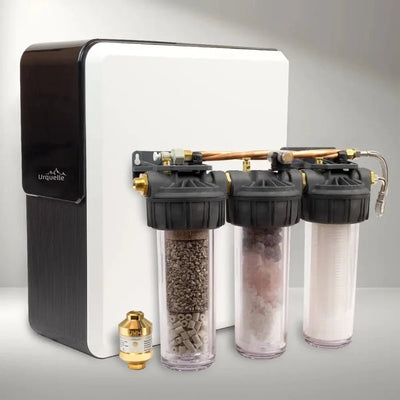
In this picture, a classic cartridge for renaturalization can be seen, which is filled with Sango sea coral.
The king class of osmosis systems - refinement systems between €3000 and €4000
In the highest price segment are systems that not only have a very high-quality and above all powerful filtration, but also renaturalize and full-spectrum energize the water (at least this should be the case with a corresponding system in this price segment - inform yourself). Aside from generally special properties, such as a manual and automatic flushing function, the water is enriched with high-quality minerals from valuable stones. In addition, the water is energized or should even be full-spectrum energized, meaning various high-quality stones, precious metals, gemstones, and mixing modules are used. Exactly the same techniques are used, which in turn reduce the cluster structure of the treated water and thereby delete the contaminated information fields. In this context, for example, our
Urquelle Diamant Water Filtration and Refinement System is composed of exactly these components.
After molecular filtration, the water first comes into contact with a special clay ceramic, which in turn breaks up the cluster structure and deletes harmful information from the water. After that, a natural germ filter ensures that contamination in the system is prevented and also filters parasites, germs, and pathogens out of the water (completely without artificial irradiation). After that, the water comes into contact with high-quality volcanic rock and a Sango sea coral, whereby it is enriched with highly bioavailable minerals. The treated water is thus given back its naturalness (a mineral sediment is created - usually 50 µS, just like in nature). Directly after that, the water flows through a module, in which a selected gemstone composition is built in (amethyst, rock crystal, rose quartz, and shungite), whereby the energy level is greatly increased. The water then flows directly into our
UMH Pure Gold Module, meaning a 24-karat gold technology, which demonstrably arranges the frequency field of water harmoniously. Finally, the water then flows through a high-quality three-way faucet, in which a real natural diamond is built in. This allows us to ensure that high-quality Urquelle spring water quality is produced from contaminated tap water.

For these reasons, such a system is also located in the high-price segment, because they are systems that not only filter water, but also comprehensively and above all in a noble way prepare it. Systems in which the best materials have been built in.
Conclusion
Ultimately, everyone must decide for themselves what osmosis system they buy and above all how much money they want to spend on it. Nevertheless, as we said, we advise against pure osmosis water. We always recommend that the water is renaturalized afterwards and above all full-spectrum energized (or generally energetically prepared). Only in this way can a water quality be created that is comparable to spring water. And ultimately, a corresponding preparation also pays off. The taste and effect are incomparable and deliver a unique experience, as if one were scooping and drinking water from a mountain spring.