TFA in Tap Water – The Invisible Danger from the Faucet?
A glass of water is one of the most basic parts of our everyday lives. That is precisely why invisible residues deserve a clear explanation. TFA is being studied more and more. What matters are its properties, the measured concentration, and a thoroughly tested treatment process for your water.
What is TFA?
TFA stands for trifluoroacetic acid. In water bodies, it predominantly exists as trifluoroacetate. The compound belongs to the particularly short-chain PFAS. It is highly water-soluble, extremely persistent, and spreads with the water cycle. This combination makes it significant for water protection. German Environment Agency: Properties of TFA
The term “forever chemical” describes environmental longevity. It does not mean that TFA remains in the body for decades. The BfR reports a half-life of two to three days and excretion predominantly through the kidneys. Environmental persistence and residence time in the body are different issues. BfR: Questions and Answers
How does TFA get into the water?
TFA can be formed during the degradation of certain fluorinated refrigerants and propellants, pesticides, and other chemicals. Industrial emissions also play a role. Precipitation, infiltrating water, and wastewater transport the substance through the water cycle. The UBA describes widespread inputs and regional hotspots of pollution. UBA: Sources and entry pathways
Location matters: A finding in one region does not allow for a direct conclusion about every tap. Swiss groundwater monitoring also shows regional differences. The most sensible starting point is an up-to-date assessment of your own water supply. BAFU: TFA in groundwater
How is TFA assessed in terms of health?
In July 2026, the EFSA lowered the acceptable daily intake to 0.014 milligrams per kilogram of body weight per day. This value applies to the total long-term intake. It is not a limit for tap water in micrograms per liter. The authority takes new data into account and identifies remaining research questions. EFSA: Re-evaluation of July 22, 2026
There is an important difference between a hazardous property of a substance and the actual risk associated with a specific exposure. According to the BfR, the amount ingested is one of the decisive factors. Evidence alone does not indicate an individual risk of illness. Measurement data, exposure and the current state of scientific knowledge must be considered together. BfR: health assessment
Understanding Your Water Test Results
Since 12 January 2026, a limit of 0.1 micrograms per litre has applied in Germany to the sum of PFAS-20. This applies to 20 compounds explicitly listed. TFA is not included in this list. A PFAS-20 analysis therefore only answers the question of TFA if TFA has also been tested and reported separately. Annex 2 to the Regulation (PFAS-20)
Pay attention to the substance, sampling date, sampling location, and unit. “Not detectable” means that the concentration is below the respective analytical limit. The limit of quantification helps to compare test results. Your water supplier will explain which analyses are available for your area. In the event of a specific finding, the public health department can help interpret its health implications.
Even a low individual measurement is just a snapshot. Longer series of measurements and information about where the raw water is sourced are more useful. This turns an isolated laboratory result into a clearer picture of the water supply. If anything is unclear, ask questions before comparing results from different regions.
What matters when filtering?
TFA places particular demands on treatment. The UBA states that conventional methods do not sufficiently remove the mobile substance. Its current FAQ lists reverse osmosis as one of the few methods with relevant removal. This produces a concentrated wastewater stream and additional energy requirements. UBA: Basics for Minimization and FAQ on Treatment
For household filters, therefore fabric-related test reports valuable. Ask about TFA testing, initial and residual concentrations, and operating conditions. General PFAS information does not replace this data. Taste and clarity alone also do not prove chemical purity. The decision also depends on installation, filter replacement, and hygienic maintenance.
Your specific water analysis and the verifiable performance data of the filter under consideration go hand in hand.
For long-term protection of water bodies, reducing further inputs is particularly important. The German Environment Agency calls for coordinated measures at the source. Every avoided release limits additional pollution throughout the water cycle. Technical treatment only comes into play once the substance has already entered the water. UBA: Effectively reduce emissions
Your Next Steps
Responsible use begins with four questions:
- Request analysis: What current values are available for your connection or supply area?
- Specifically address the TFA: Was the substance tested individually, and with what limit of quantification?
- Evaluate the findings: What do the water suppliers or public health department say about this?
- Check treatment: What certified performance and ongoing requirements does the system have?
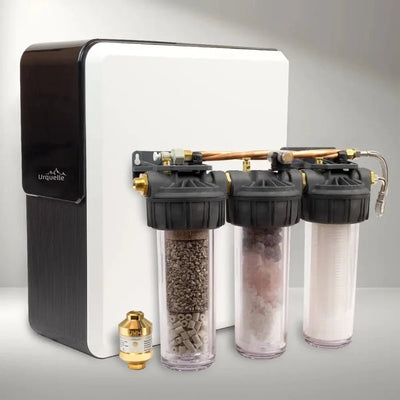
According to the product description, the DIAMANT Urquelle combines reverse osmosis with additional treatment and refinement stages. Together, we can review the source water, installation conditions, and suitable supporting documentation. A TFA-specific retention rate should be supported by a corresponding test report. Get to know the DIAMANT system
Use water consciously
TFA is a long-term task for protecting our water resources. Fewer inputs, good monitoring data, and effective treatment complement each other. An up-to-date analysis provides more clarity than blanket statements about all PFAS. This way, you can make an informed choice about water quality, whose properties and treatment you can understand.
We review analysis data, systems, and the installation situation together with you.
Sources and further information
- Urquelle: original post, July 2025
- German Environment Agency: TFA FAQ, June 2026
- UBA: Sources and entry pathways, 2021
- UBA: Fundamentals for Minimization, 2023
- EFSA: new intake values, July 2026
- BfR: Questions and Answers, July 2026
- Annex 2 to the Regulation (PFAS-20)
- BAFU: Groundwater Monitoring, 2026