Nowadays, more and more people are starting to filter their tap water. Due to countless chemical contaminants, namely pharmaceutical residues, plasticizers, pesticides/herbicides, but also heavy metals and microplastics, a major shift in thinking is taking place. Pure water and its incredible benefits for the human body are therefore coming back into focus for many people, which is why reverse osmosis technology in particular is increasingly being used in many households.
But a classic reverse osmosis system has many disadvantages. Of course, tap water can be filtered to a high degree of purity using this technology. Water is pressed through membranes under high pressure, which removes even molecular contaminants from tap water. But that is merely the first step towards producing spring water, ideally even pristine spring water.
The disadvantages of untreated filtered water
Highly pure filtration creates three serious disadvantages, for example. The first disadvantage is the continued saturation of the water with harmful information, meaning that although the water is filtered to a high degree of purity, the contaminant information is still bound in the water.
The same applies to the energy level or frequency field of the water, which still shows massive damage. On the other hand, the pH value shifts into the acidic range. Last but not least, an osmosis system (the same problem obviously also occurs with distillation) removes all minerals from tap water. Well, the minerals bound in tap water are mostly inorganic in nature, which here primarily refers to the energy quality of the minerals, meaning the frequency/spin is too low, so that the body cannot optimally absorb the minerals.
But especially the missing minerals represent a serious problem here. Especially in the water filter scene, it is repeatedly propagated that water should be free of everything, even minerals, whereby the corresponding water could only then fulfill its main tasks. But water without minerals (and free of contaminants) is so empty that it has an extremely aggressive dissolving power. The aggressiveness is so strong that such water even dissolves precious metals such as gold over time (in constant contact). In the body itself, it furthermore dissolves valuable minerals and energies out of the body's own cells. In the short term, the effect can be very detoxifying, but in the long term, it attacks the body itself (similar to what happens with the gold example).
On the other hand, and this is one of the most fundamental points of all, water without minerals loses its natural protection. It therefore spoils quickly under sunlight, which is why completely pure osmosis water begins to smell stronger even after several hours after bottling. The water is unprotected from external influences and radiation and does not even show any energetic stability itself. Ultimately, this is also a reason why in nature you do not come across a spring where no minerals are bound.
Why water should be mineralized!
The purest or most remote pristine springs always show a sediment of minerals. Pristine spring water is therefore highly pure, but not free of minerals. Added to this is the fact that water without minerals is difficult to energize. Due to a lack of a resonance basis, which in turn is due to a lack of natural minerals, such water finds it difficult to maintain a high energy level. The same applies to a hexagonal structure, which on the one hand is difficult to produce, on the other hand cannot hold for long. Ultimately, nature makes a perfect example of this for us.
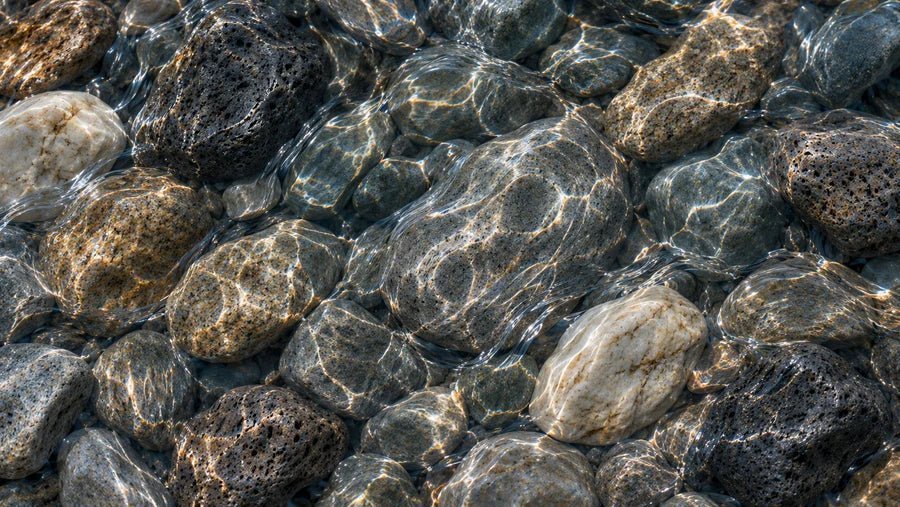
Within a mountain spring or a stream, spring water is enriched in a natural way through friction and general contact with various rocks with natural and above all high-frequency minerals. The water therefore charges itself with the power of nature. After filtering water, regardless of how the filtration is carried out, it is therefore absolutely necessary to enrich the water with organic and ideally even highly bioavailable minerals.
Sango Sea Coral
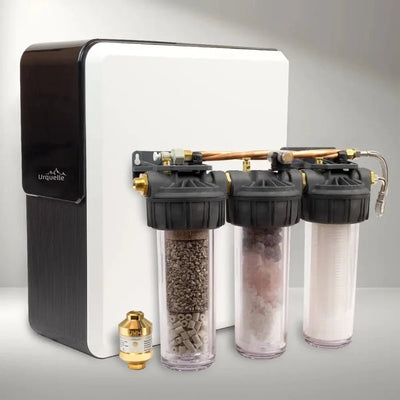
For this reason, for example, two special mineralization sources are used in the Urquelle®Diamant system. In general, we can highly recommend these two mineralization sources for the preparation of osmosis water. For example, the preparation through a Sango Sea Coral can be perfectly utilized. The Sango Sea Coral from Okinawa exhibits, for example, an ideal mineral ratio of over 70 minerals and trace elements. These minerals are highly bioavailable and also exhibit a similar vibrational frequency to that of the human body. Furthermore, a cartridge with Sango Sea Coral increases the pH value of the water by a factor of 2, whereby tap water treated by osmosis returns to the neutral range. In this way, the water regains its natural resonance basis and gains significantly in naturalness and freshness.
Maifan Mineral Rock
Another very powerful way to remineralize osmosis water is through the special Maifan mineral rock. This rock, recognized in Chinese medicine, has a volcanic origin and consists in the core of various high-quality silicates (silicon). Although the pH-raising effect is not as strong as with a Sango Sea Coral, the water is also charged with highly bioavailable minerals. The energy of the mountains is also transferred to the treated water, which ultimately makes itself noticeable in that the water tastes significantly fresher, more mountainous, and more natural afterwards.
Restoring Water to Its Originality
Now, in conclusion, we can therefore only point out the importance of remineralization. Osmosis water becomes significantly fresher, softer, more digestible through appropriate preparation and ultimately gains massively in naturalness. Especially when we aim for the production of spring water quality or even pristine spring water quality, mineralization is an indispensable factor. Pristine spring water always shows a sediment of minerals, which is why we should also take nature as a model in this case.